

 Arohi Publications

IRAN: Political Regime, Evolution and Internal Contradictions
Nature of Political Regime
- Iran is an Islamic Republic combining theocracy and republicanism
- Theocratic element means rule by religious clergy
- Republican element includes elected institutions like President and Parliament
- Foundational doctrine is Velayat-e Faqih (Guardianship of Islamic Jurist)
- Ultimate authority lies with a religious leader, not the people
Power Structure
- Supreme Leader is the highest authority controlling military, judiciary, media and foreign policy
- President is elected but has limited powers
- Parliament (Majlis) performs legislative functions
- Guardian Council vets candidates and laws
- Islamic Revolutionary Guard Corps acts as a powerful military and economic institution
Key Insight
- Iran functions as a dual state where elected institutions exist but unelected bodies dominate
Historical Evolution
Pre-1979 Monarch
- Ruled by Mohammad Reza Pahlavi
- Characterised by authoritarian rule and Western alignment
- Rapid modernization without political freedom
1979 Islamic Revolution
- Led by Ruhollah Khomeini
- Overthrew monarchy and established Islamic Republic
- Clergy became the ruling elite
- State adopted anti-West ideological stance
Post-Revolution Consolidation
- Iran-Iraq War strengthened regime legitimacy
- Expansion of clerical institutions
- Rise of IRGC as a key power centre
Khamenei Era
- Led by Ali Khamenei since 1989
- Increasing centralisation of power
- Expansion of security apparatus
- Strong ideological control
Contemporary Phase
- Leadership transition pressures
- Growing role of military-clerical nexus
Core Features
Dual Legitimacy
- Combination of divine legitimacy and popular legitimacy
- Creates inherent structural tension
Controlled Democracy
- Regular elections are conducted
- Candidates are filtered, limiting real competition
Deep State Structure
- IRGC and clerical elite dominate economy, security and foreign policy
Patronage System
- Loyalty rewarded through economic benefits
- Helps maintain regime stability
Internal Contradictions
Democracy versus Theocracy
- People vote but ultimate authority lies with clergy
- Results in limited democratic choice
Accountability versus Absolute Power
- Oversight institutions exist but are controlled by same elite
- Weak accountability mechanism
Anti-Monarchy versus Dynastic Tendencies
- Revolution opposed hereditary rule
- Signs of informal succession politics emerging
Ideology versus Pragmatism
- Anti-West stance in ideology
- Practical need for trade and diplomacy
Public Aspirations versus Regime Control
- Youth demand freedom and reforms
- State maintains conservative control
- Leads to protests and unrest
Economic Justice versus Elite Capture
- Revolution promised equality
- Economic dominance by IRGC and elite groups
- Leads to inequality and corruption perception
Centralisation versus Institutional Complexity
- Multiple institutions exist
- Final authority remains centralised
- Causes governance inefficiency
Stability versus Repression
- Stability ensured through coercion
- Repression leads to long-term instability

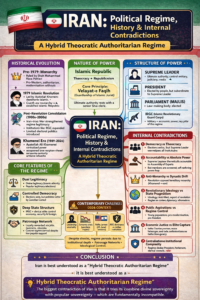
Contemporary Challenges
- Leadership succession uncertainty
- Economic crisis due to sanctions
- Rising public dissatisfaction
- External geopolitical pressure
- Increasing dominance of IRGC
Factors Supporting Regime Survival
- Strong institutional structure
- Patronage networks
- Ideological legitimacy
Conclusion
- Iran is neither a full democracy nor a simple dictatorship
- It is best described as a hybrid theocratic-authoritarian system
- The core contradiction lies between divine sovereignty and popular sovereignty
Final Insight
- The attempt to combine religious authority with democratic participation creates both resilience and instability in the system
Discover more from Politics by RK: Ultimate Polity Guide for UPSC and Civil Services
Subscribe to get the latest posts sent to your email.

