

 Shivaji Tripathi

1. Philosophical Foundation
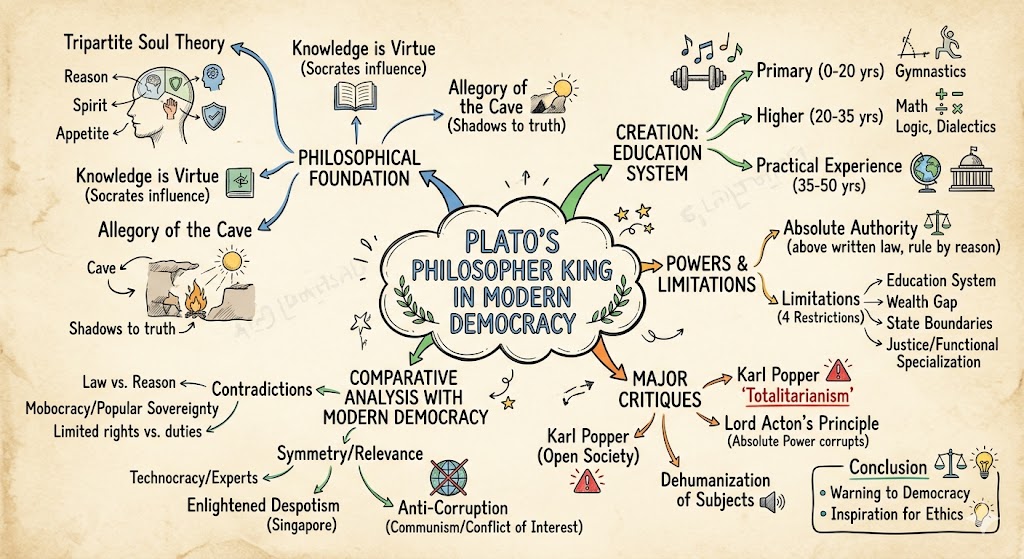
The concept of the Philosopher King is not an isolated idea but the logical conclusion of Plato’s preceding theories:
- Tripartite Theory of the Soul: Plato argues that the human soul consists of three elements: Reason, Spirit, and Appetite. Only those in whom ‘Reason’ dominates are fit to rule.
- Knowledge is Virtue: Influenced by Socrates, Plato believed politics is both an art and a science. Just as a sick person needs a doctor (an expert), the state needs an ‘expert’ (philosopher) to govern.
- Allegory of the Cave: This illustrates that the masses only see shadows (illusions) and mistake them for reality. The philosopher is the one who has stepped out of the cave and seen the actual sun (the Truth/The Idea of Good).
2. Creation of the Philosopher King: The Education System
Plato’s ruler is not born by chance but is crafted through a rigorous 50-year education scheme:
- Primary Education (0-20 years): Character building through Music and Gymnastics.
- Higher Education (20-35 years): Intensive study of Mathematics, Logic, and Dialectics.
- Practical Experience (35-50 years): Exposure to the hardships of the world and practical politics.
Only the one who emerges superior after this 50-year ‘ordeal’ is eligible to become the Philosopher King.
3. Powers and Limitations
Plato grants his king absolute power, yet he is not a Tyrant.
Absolute Authority: The king is restricted neither by written law nor by public opinion. Plato’s famous quote: “No law or ordinance is mightier than knowledge.”
Four Major Restrictions: Though above the law, the king cannot alter the fundamental structure of the ‘Ideal State’:
- He must not change the system of education.
- He must not allow the gap between wealth and poverty to widen.
- He must not expand the state’s boundaries to the point of compromising unity.
- He must maintain the principle of Justice (Functional Specialization).
Comparative Analysis with Modern Democracy
The relationship between modern democracy and Plato’s Philosopher King is a complex mix of contradiction and symmetry.
4. Fundamental Contradictions with Democracy
- Law vs. Reason: Modern democracy is based on Constitutionalism and the Rule of Law. Plato rejects this because he views law as a product of “average intelligence” that hinders “extraordinary wisdom.”
- Popular Sovereignty: Democracy believes in “government by the people.” Plato calls this ‘Mobocracy’. For him, ruling is a skill; just as a ship needs a captain, a state needs an expert.
- Rights and Liberty: Democracy grants fundamental rights. In Plato’s state, citizens have only one ‘right’—to perform their assigned duty (Swadharma).
5. The ‘Shadow’ of Plato in Modern Democracy (Relevance)
Despite rejecting Plato’s absolutism, elements of his thought persist in modern systems:
- Meritocracy: Modern Civil Services (IAS, IPS) and Technocrats are miniature versions of the Philosopher King. Complex policy-making still requires highly educated experts.
- Enlightened Despotism: The development of countries like Singapore (under Lee Kuan Yew) is often cited as a successful practical application, where discipline and expertise were prioritized over populist demands.
- Safeguard Against Corruption: Plato’s ‘Communism of Property’ aimed to prevent the union of power and wealth. Modern Conflict of Interest laws are rooted in this very concern.
6. Major Critiques
- Karl Popper’s Attack: In ‘The Open Society and Its Enemies’, Popper labeled Plato the father of Totalitarianism. He argued that the claim “I alone know the truth” inevitably leads to dictatorship.
- Lord Acton’s Principle: “Power tends to corrupt, and absolute power corrupts absolutely.” Plato’s assumption that a philosopher would remain incorruptible is seen as contrary to human nature.
- Dehumanization of Subjects: By treating citizens as mere ‘producers’ or ‘soldiers’, Plato denies them political maturity, reducing them to ‘silent subjects’.
7. Conclusion: A Balanced Perspective
Plato’s Philosopher King serves as both a Warning and an Inspiration for modern democracy.
- Warning: If democracy becomes a mere ‘number game’ and ignores knowledge/wisdom, it will decay.
- Inspiration: Politics should not be a means for power but a field of selfless service and high moral standards.
Key Terminology for UPSC Answers
- Gorgias: Plato’s dialogue where he critiques democracy.
- Nocturnal Council: A later alternative to the Philosopher King found in Plato’s book ‘The Laws’.
- Intellectual Aristocracy: Rule by the intellectually elite.
- Functional Specialization: Each part of the soul/state doing what it is best suited for.
UPSC PYQs
- “No law or ordinance is mightier than knowledge, but knowledge should not be fettered by law.” Explain in the context of Plato.
- “Until philosophers are kings… cities will never have rest from their evils.” Comment.
- Critically examine: “Plato’s Philosopher King is a symbol of Enlightened Despotism.”
- “Plato is the first totalitarian thinker.” (Karl Popper). Do you agree? Give reasons.
- Analyze the tension between the ‘Rule of Knowledge’ and ‘Modern Democracy’.
Discover more from Politics by RK: Ultimate Polity Guide for UPSC and Civil Services
Subscribe to get the latest posts sent to your email.

